Why Collin Gillespie’s Surprise $48M Deal Could Actually Be Good News for Boston
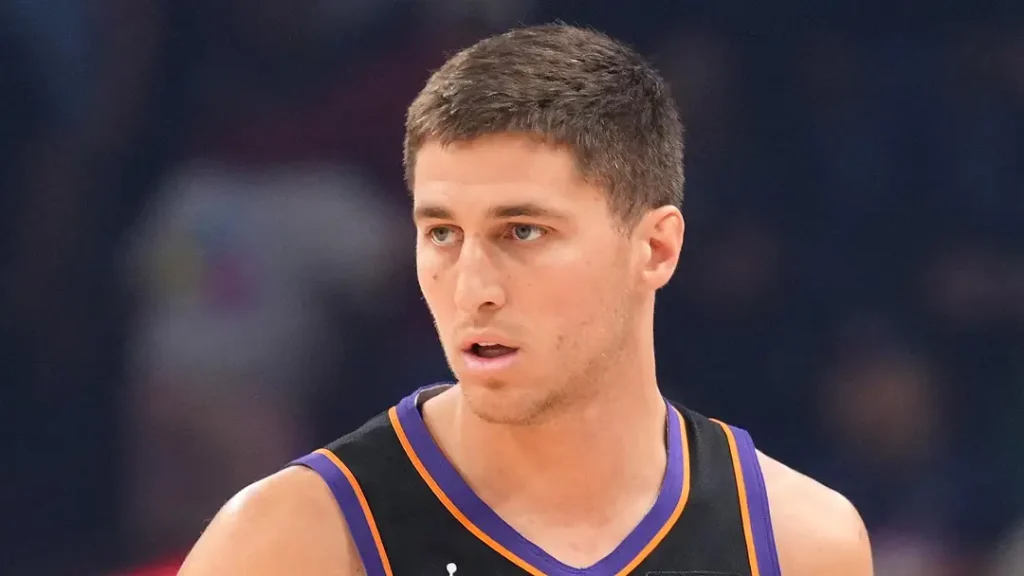
The Phoenix Suns’ decision to lock in Collin Gillespie on a four-year, $48 million contract is one of the first notable moves of the NBA offseason—and while it looks like a straightforward win for Phoenix, it also sends ripple effects across the league, especially for teams like the Boston Celtics who are preparing to be active in free agency.
For Gillespie, this is a major breakthrough moment. After going undrafted out of Villanova in 2022, he spent multiple seasons grinding on two-way contracts, fighting for stability and consistent minutes. Now, at nearly 27 years old, he has finally earned a long-term NBA commitment and a significant financial jump. His rise from fringe roster player to rotation staple has been gradual but steady, and Phoenix is clearly betting that his development has reached a new level.
A strong contract for Phoenix—and a surprising market signal
From Phoenix’s perspective, the deal is arguably a bargain. Gillespie’s production last season suggests he may have been undervalued relative to the contract he just received. That’s exactly why the agreement matters beyond just one player: it hints at how teams are valuing mid-tier guards in today’s market.
For Boston, that market signal is important.
On the surface, it’s easy to see why the Celtics might regret missing out. Gillespie projects as an ideal third guard—someone capable of handling the ball, creating offense, and fitting seamlessly both on and off the ball. His steady decision-making, defensive effort, and toughness make him the type of rotation player championship teams often rely on when games tighten in the postseason.
Given Boston’s flexibility with the mid-level exception, they theoretically had enough financial firepower to outbid Phoenix and bring him in as a plug-and-play rotation piece for a title run.
Why Boston might actually benefit from this deal
However, the larger takeaway is more encouraging for Boston than disappointing.
If a player like Gillespie—productive but not yet considered a full-scale star—is settling at $12 million per year, it suggests the free-agent market may be less inflated than expected. That creates opportunity. The Celtics enter the offseason with the full mid-level exception (around $15 million), and this deal implies that amount could still be highly competitive rather than merely average.
That flexibility gives Boston room to:
- Target undervalued rotation guards and wings
- Retain internal depth pieces such as Neemias Queta and Jordan Walsh on reasonable contracts
- And still compete for external free agents without overpaying in a tight market
In other words, the Gillespie contract effectively resets expectations for what “good value” looks like in this free-agent class.
Production that justifies the buzz
Gillespie’s breakout season in Phoenix wasn’t just narrative-driven—it was backed by real production. Appearing in 80 games and starting 58 of them, he logged heavy minutes and responded with consistent efficiency.
He averaged:
- 12.7 points per game
- 4.6 assists per game
- 4.1 rebounds per game
- 40% shooting from three-point range
But his impact extends beyond the box score. He brings stability as a floor general, keeps offenses organized, and plays with a level of composure that reflects his championship pedigree at Villanova, where he won a national title and earned Big East Player of the Year honors.
Those traits don’t always show up in advanced metrics, but they are exactly what coaches value in high-pressure rotations.
What it means for Boston going forward
The key takeaway for the Celtics is simple: this market is workable.
Even though Gillespie would have been a strong stylistic fit in Boston—particularly as a reliable third guard—the structure of his deal suggests that comparable players may still be attainable without needing to stretch beyond the mid-level exception.
That gives Boston options, not limitations. If the right opportunity presents itself, they still have the financial power to strike. And if not, this offseason still offers enough undervalued talent to reinforce the roster around their core.
In that sense, Gillespie’s deal is both a missed opportunity and a useful benchmark. It clarifies the price of solid rotation guards in this market—and reassures Boston that meaningful upgrades are still well within reach.